
Densah® Drill in Dental Implant Treatment: A More Advanced Approach to Bone Preservation
Dental implants are one of the most reliable ways to replace missing teeth, helping patients restore their smiles, chewing function and confidence. However, successful dental implant treatment depends on more than simply placing an implant into the jawbone. The quality, quantity and stability of the surrounding bone also play important roles.
With advancements in modern implant dentistry, new technologies have been developed to improve how the jawbone is prepared before implant placement.
One such innovation is the Densah® Drill system, which uses a technique known as osseodensification. Unlike conventional drilling methods that primarily remove bone to create space for an implant, this technique is designed to compact and preserve bone during implant site preparation.
At The Smile Dental Lounge in Johor Bahru, we believe in embracing modern dental technologies and treatment approaches to provide patients with carefully planned and personalised dental implant care.
What Is a Densah® Drill?
The Densah® Drill is a specialised dental surgical instrument designed for a technique called osseodensification.
It is used during dental implant surgery to prepare the area of the jawbone where the dental implant will be placed.
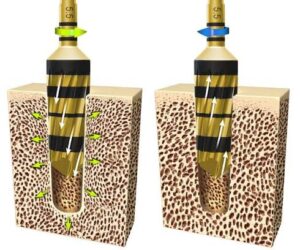
Traditional dental implant drilling generally involves removing bone to create an opening that accommodates the implant. In contrast, the Densah® Drill uses specially designed burs that can compact and densify the surrounding bone under the appropriate drilling conditions.
This process helps preserve bone particles and redistribute them along the walls of the prepared implant site.
The objective is to create a denser bone environment around the implant, potentially improving initial implant stability, particularly in areas where the bone has lower density.
What Is Osseodensification in Dental Implant Surgery?
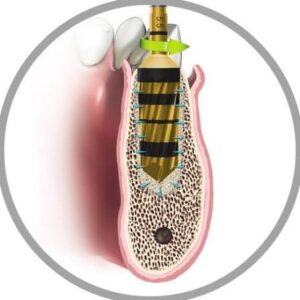
Osseodensification is an innovative bone preparation technique developed to improve the way dental implant sites are prepared.
The technique uses specially designed Densah® burs that operate in different rotational modes.
During the densifying mode, the burs rotate in a counterclockwise direction under continuous irrigation. Rather than primarily cutting away bone, they compact the bone along the walls of the implant preparation site.
This process may offer several advantages:
- Bone preservation: Helps retain and redistribute bone particles instead of removing all the surrounding bone during preparation.
- Increased bone density: Compacts the surrounding bone, potentially creating a denser environment for implant placement.
- Improved primary stability: May help achieve better initial mechanical stability of dental implants, particularly in softer bone.
- Potential bone expansion: Can assist in managing selected narrow bone ridges through controlled bone expansion.
- Autogenous bone preservation: Retains local bone particles that may contribute to the bone healing and remodelling process.
The technique is particularly interesting in cases where the available bone is relatively soft or has limited width. However, its suitability depends on the patient’s individual bone anatomy and clinical condition.
How Does the Densah® Drill Work?
The Densah® Drill system works differently from conventional implant drills.
Here is a simplified explanation of how the technique is performed:
- Detailed Assessment and Treatment Planning
Before dental implant surgery, the dentist evaluates the patient’s oral health, available bone volume and bone quality.
Dental imaging, including Cone Beam Computed Tomography (CBCT) when indicated, may be used to assess the jawbone in three dimensions and identify important anatomical structures.
This information helps determine the appropriate implant position, size and surgical approach.
- Preparation of the Implant Site
The initial implant site is prepared using an appropriate pilot drill to establish the planned depth and direction.
The dentist then selects the suitable Densah® burs according to the implant system, bone condition and planned implant dimensions.
- Osseodensification Process
The specialised Densah® burs are used in densifying mode with appropriate irrigation.
As the burs rotate, they compact the surrounding bone and redistribute bone particles along the walls of the implant site.
This creates a prepared implant bed with the aim of improving the mechanical environment for implant placement.
- Dental Implant Placement
Once the implant site has been prepared, the dental implant is carefully positioned into the jawbone.
The dentist assesses the implant’s primary stability and determines the appropriate healing and loading protocol.
- Healing and Osseointegration
Following implant placement, the surrounding bone gradually heals and integrates with the implant surface. This biological process is known as osseointegration.
The healing period varies depending on bone quality, implant stability, surgical complexity and individual healing factors.
Once adequate integration has been achieved, the final dental crown can be placed to restore the appearance and function of the missing tooth.
Benefits of Using Densah® Drill for Dental Implants
Osseodensification offers several potential clinical advantages compared with conventional implant site preparation.
- Helps Improve Initial Implant Stability
Primary stability refers to the initial mechanical stability of a dental implant immediately after placement.
Achieving sufficient primary stability is important because excessive movement during the healing period may interfere with successful osseointegration.
By compacting the surrounding bone, the Densah® technique may help improve initial implant stability, especially in areas with lower-density bone.
- Preserves and Compacts Existing Bone
One of the key features of osseodensification is its ability to compact bone rather than relying solely on bone removal.
The technique helps retain and redistribute bone particles around the implant preparation site.
This may be beneficial in situations where maintaining the available bone volume is particularly important.
- Potentially Useful in Softer Bone
Some patients have naturally softer or less dense jawbone, particularly in certain areas of the upper jaw.
Lower bone density can make achieving adequate implant stability more challenging.
Osseodensification may help improve the mechanical conditions of the implant site in selected cases.
- Supports Bone Expansion in Selected Cases
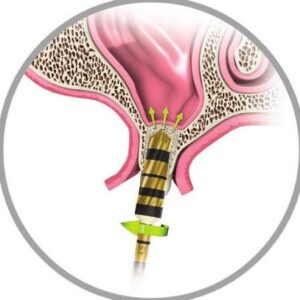
In patients with a relatively narrow jawbone ridge, carefully controlled osseodensification may help facilitate bone expansion during implant site preparation.
This can be useful in selected clinical situations where the available bone width needs to be managed carefully.
However, significant bone deficiencies may still require additional bone grafting procedures.
- An Additional Option in Modern Implant Dentistry
Densah® technology provides dentists with another approach to implant site preparation.
Rather than using one drilling method for every patient, the dentist can select the most appropriate technique according to the patient’s bone condition, anatomical requirements and treatment objectives.
Densah® Drill vs Conventional Dental Implant Drilling
What is the difference between conventional drilling and osseodensification?
Feature | Conventional Drilling | Densah® Osseodensification |
Main approach | Removes bone to prepare the implant site | Compacts and densifies bone in densifying mode |
Bone particles | Bone is removed during drilling | Bone particles are retained and redistributed |
Bone density | Does not specifically aim to densify surrounding bone | Designed to increase local bone density |
Primary stability | Depends on bone quality and surgical technique | May improve primary stability in selected cases |
Bone expansion | Limited by the conventional preparation approach | May facilitate controlled bone expansion in suitable cases |
Both techniques have important roles in implant dentistry. The best approach depends on the patient’s individual bone condition and the dentist’s clinical assessment.
Who May Benefit from Densah® Drill Dental Implant Treatment?
Osseodensification may be considered for patients who require dental implant treatment in situations such as:
- Patients with relatively soft or low-density jawbone.
- Patients with limited bone width who may benefit from controlled bone expansion.
- Patients requiring dental implants in selected areas of the upper jaw.
- Patients where preserving existing bone during implant preparation is an important treatment consideration.
- Selected cases where achieving adequate initial implant stability may be challenging.
It is important to understand that Densah® technology is not suitable or necessary for every dental implant patient.
Some patients may achieve excellent results using conventional drilling techniques, while others may benefit from an osseodensification approach.
A thorough clinical examination and appropriate dental imaging are necessary to determine the most suitable treatment.
Does Using a Densah® Drill Mean I Can Avoid Bone Grafting?
This is a common question among patients considering dental implants.
The Densah® Drill may help manage certain situations involving limited bone width by facilitating controlled bone expansion and bone compaction.
However, it does not eliminate the need for bone grafting in every case.
Patients with significant bone loss, insufficient bone volume or complex anatomical limitations may still require additional procedures such as bone augmentation or guided bone regeneration.
The dentist will evaluate the available bone and recommend the most appropriate treatment plan based on individual needs.
Is Densah® Osseodensification Better Than Conventional Drilling?
Both conventional drilling and osseodensification are established approaches to preparing dental implant sites.
Research suggests that osseodensification may offer advantages in certain situations, particularly when dealing with low-density bone and when improved initial implant stability is desirable.
However, clinical evidence is still evolving, and research has not consistently demonstrated superior long-term outcomes for every patient or clinical situation.
The success of dental implant treatment continues to depend on several important factors, including:
- The patient’s overall oral and general health.
- The quantity and quality of available jawbone.
- Proper implant positioning and surgical planning.
- The dentist’s experience and surgical technique.
- Good oral hygiene and regular implant maintenance.
The choice of drilling technique should always be guided by sound clinical judgement rather than technology alone.
Advanced Dental Implant Treatment at The Smile Dental Lounge, Johor Bahru
At The Smile Dental Lounge, we understand that every patient has different dental needs and expectations.
Our approach to dental implant treatment focuses on careful assessment, appropriate treatment planning and the use of suitable dental technologies to support predictable clinical outcomes.
We believe that modern implant dentistry is about selecting the right treatment approach for each individual patient.
Whether you are missing a single tooth, several teeth or looking for a long-term solution to replace missing teeth, our dental team can assess your condition and discuss suitable treatment options.
If you are considering dental implants in Johor Bahru, we welcome you to visit The Smile Dental Lounge for a consultation.
Let us help you take the next step towards restoring your smile and confidence.
Frequently Asked Questions (FAQs)
- What is a Densah® Drill used for in dental implants?
A Densah® Drill is a specialised surgical instrument used in osseodensification. It helps compact and densify the surrounding bone during dental implant site preparation rather than relying solely on removing bone.
- Is Densah® Drill technology safe?
When used by appropriately trained dental professionals with proper clinical assessment and surgical protocols, osseodensification can be a useful technique in dental implant surgery. As with all surgical procedures, potential risks and complications should be discussed with your dentist.
- Does the Densah® Drill make dental implants heal faster?
Osseodensification may improve initial implant stability and support favourable early healing conditions in selected cases. However, it does not guarantee faster healing. The healing period depends on individual bone quality, implant stability and overall health.
- Can Densah® Drills be used for patients with soft jawbone?
Yes. One of the main clinical applications of osseodensification is in areas with relatively low-density bone, where improving initial implant stability may be beneficial.
- Can Densah® Drills eliminate the need for bone grafting?
Not always. Although the technique may facilitate bone expansion and help preserve existing bone in selected cases, patients with significant bone deficiencies may still require bone grafting.
- How long does a dental implant take to heal?
Healing time varies between patients. Osseointegration commonly takes several months, depending on the patient’s bone condition, implant stability and treatment protocol. Your dentist will determine when the implant is ready for the final restoration.
- Where can I get dental implant treatment in Johor Bahru?
If you are looking for dental implant treatment in Johor Bahru, you can visit The Smile Dental Lounge for a consultation. Our dental team can assess your oral condition and discuss suitable implant treatment options based on your needs.
Book Your Dental Implant Consultation Today
Thinking about replacing your missing teeth with dental implants?
Discover modern implant dentistry and learn whether Densah® Drill osseodensification may be suitable for your treatment.
The Smile Dental Lounge
Johor Bahru, Johor, Malaysia
Contact our clinic today to arrange a dental implant consultation and take the first step towards a healthier, more confident smile.
Your smile deserves personalised care.