

Invisalign vs Traditional Braces: Which Should You Choose?
Are you considering straightening your teeth but unsure whether to choose Invisalign or traditional braces?
Both Invisalign and traditional braces are effective orthodontic treatments designed to correct misaligned teeth, improve your bite and create a healthier, more confident smile. However, they differ in appearance, comfort, convenience, maintenance and treatment requirements.
At The Smile Dental Lounge in Johor Bahru, we believe that choosing the right orthodontic treatment should be based on your dental condition, lifestyle and personal preferences.
In this guide, we will compare Invisalign vs traditional braces to help you understand their differences and decide which treatment may be more suitable for you.
1. What Is Invisalign?
Invisalign is an orthodontic treatment that uses a series of custom-made, transparent plastic aligners to gradually move your teeth into their desired positions.
Unlike conventional braces, Invisalign does not use metal brackets or wires. Instead, each set of clear aligners applies controlled pressure to specific teeth, gradually guiding them towards their planned positions.
Key features of Invisalign:
Nearly invisible appearance.
Custom-made clear aligners.
Removable for eating and drinking.
Can be removed for brushing and flossing.
No metal brackets or wires.
Digital treatment planning to visualise the planned tooth movements.
Invisalign aligners are generally worn for approximately 20–22 hours daily, with each aligner changed according to the orthodontic treatment plan.
They offer a convenient option for adults and teenagers who prefer a more discreet way to straighten their teeth.

2. What Are Traditional Braces?
Traditional braces are fixed orthodontic appliances that use brackets attached to the teeth and connected by orthodontic wires.
The wires apply controlled forces to gradually move the teeth into their desired positions. Your dentist or orthodontist will periodically adjust the braces throughout the treatment process.
Key features of traditional braces:
Fixed to the teeth throughout treatment.
Suitable for correcting various orthodontic problems.
Continuous force is applied to move teeth.
No need to remember to wear or remove aligners.
Available in different bracket options, including metal and ceramic braces.
Traditional braces have been used for many years and remain a reliable treatment option for patients with different types of dental malocclusions.
3. Invisalign vs Traditional Braces: What Are the Differences?
Understanding the differences between Invisalign and traditional braces can help you make a more informed decision.
Appearance
Invisalign:
Invisalign uses transparent aligners that fit closely over your teeth. They are much less noticeable than conventional metal braces, making them popular among working professionals, adults and teenagers who prefer a discreet orthodontic treatment.
Traditional braces:
Metal braces are more visible because of their brackets and wires. However, ceramic braces offer a less noticeable alternative because their brackets are designed to blend more closely with the natural tooth colour.
Winner: Invisalign
If appearance is your main priority, Invisalign generally offers a more discreet treatment experience.
Comfort
Invisalign:
The aligners are made from smooth plastic, without metal brackets or wires that may irritate the inside of your cheeks and lips. You may experience temporary pressure or discomfort when changing to a new set of aligners.
Traditional braces:
Brackets and wires may cause irritation to the cheeks, lips and tongue, particularly during the initial adjustment period or after orthodontic appointments.
Winner: Invisalign
Many patients find Invisalign more comfortable because it does not have protruding metal components.
Eating and Drinking
Invisalign:
One of the biggest advantages of Invisalign is that the aligners are removable.
You can remove them during meals and enjoy your usual foods without worrying about food getting stuck between brackets and wires.
However, aligners should generally be removed when eating or drinking anything other than plain water.
Traditional braces:
Braces remain attached to your teeth throughout treatment. Certain hard, sticky and chewy foods should be avoided because they may damage brackets or orthodontic wires.
Winner: Invisalign
Invisalign provides greater flexibility when eating and drinking.
Oral Hygiene and Cleaning
Invisalign:
Since Invisalign aligners are removable, you can brush and floss your teeth normally.
You should also clean your aligners regularly to maintain good oral hygiene and prevent unpleasant odours or bacterial accumulation.
Traditional braces:
Brushing and flossing can be more challenging because food particles may become trapped around brackets and wires.
Special orthodontic toothbrushes, interdental brushes and flossing aids may be helpful.
Winner: Invisalign
Invisalign generally makes daily oral hygiene easier because the aligners can be removed.
Treatment Duration
Invisalign:
Treatment duration depends on the complexity of your dental condition and how consistently you wear your aligners.
Some cases may take several months, while more complex cases may require longer treatment.
Patients must wear their aligners for approximately 20–22 hours daily to achieve the planned tooth movements.
Traditional braces:
Traditional braces commonly require approximately 18–24 months, although treatment may be shorter or longer depending on the individual case.
Winner: It depends
Neither treatment is automatically faster. Your dental condition and treatment compliance are important factors in determining the overall duration.
Effectiveness
Invisalign:
Invisalign can correct many orthodontic concerns, including:
Crowded teeth.
Gaps between teeth.
Mild to moderate overbite.
Underbite.
Crossbite.
Certain open bite conditions.
Some complex tooth movements may require additional techniques or may be more predictable with fixed braces.
Traditional braces:
Traditional braces can treat a wide range of orthodontic conditions, including more complex tooth movements and certain challenging bite problems.
Winner: Depends on your dental condition
Both treatments can produce excellent results when appropriately selected and professionally monitored. The most suitable option depends on your individual orthodontic needs.
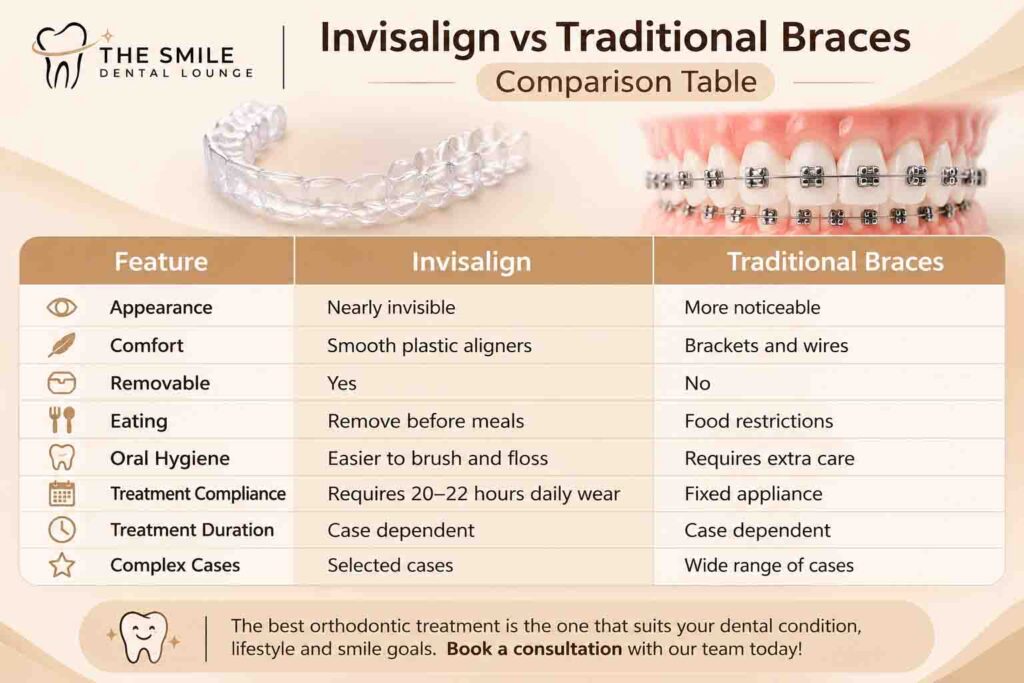
4. Invisalign vs Traditional Braces: Comparison Table
5. How Much Does Invisalign Cost Compared to Traditional Braces in Malaysia?
The cost of Invisalign and traditional braces in Malaysia varies depending on several factors.
These include:
Complexity of your dental alignment.
Severity of crowding or bite problems.
Expected treatment duration.
Type of orthodontic system selected.
Additional procedures that may be required.
Invisalign may have a different treatment fee compared to conventional braces due to its customised digital planning and aligner manufacturing process.
However, the most appropriate treatment should not be selected based on price alone.
A proper dental assessment will help determine the treatment options, expected duration and associated costs based on your individual needs.
For patients considering Invisalign in Johor Bahru, a consultation at The Smile Dental Lounge can help you understand whether clear aligner treatment is suitable for your smile.
Our Invisalign package starts from RM9900 to RM20000, please feel free to schedule an appointment for free iTero scan and consultation with our doctors to know more about how Invisalign can help in your case.
6. Who Is a Suitable Candidate for Invisalign?
Invisalign may be suitable for individuals who:
Prefer a discreet orthodontic treatment.
Have crowded or misaligned teeth.
Have spaces or gaps between their teeth.
Have certain bite alignment problems.
Prefer removable aligners for eating and cleaning.
Can commit to wearing aligners consistently for 20–22 hours daily.
However, Invisalign may not be suitable for everyone.
Patients with certain complex orthodontic conditions may benefit more from traditional braces or a combination of orthodontic techniques.
A comprehensive dental examination is necessary before deciding on the most appropriate treatment.
7. Why Is Digital Treatment Planning Important?
Modern orthodontic treatment increasingly incorporates digital technology to improve treatment planning and patient communication.
With digital intraoral scanning, dental impressions can be captured using a specialised scanner instead of traditional impression materials.
For Invisalign treatment, digital scans and treatment planning help create a customised sequence of aligners designed to achieve the planned tooth movements.
Patients may also be able to view a digital simulation of their anticipated treatment outcome, helping them understand the proposed treatment process.
At The Smile Dental Lounge, we value modern dental technology and personalised treatment planning to support a more informed patient experience.
8. Invisalign or Traditional Braces: Which Should You Choose?
There is no single answer that applies to everyone.
Choose Invisalign if:
You prefer a nearly invisible orthodontic option.
You want the convenience of removable aligners.
You prefer easier brushing and flossing.
You can commit to wearing aligners consistently.
Your orthodontic condition is suitable for clear aligner treatment.
Consider traditional braces if:
You have more complex orthodontic requirements.
You prefer a fixed treatment option.
You do not want to worry about removing and wearing aligners.
Your dentist recommends fixed braces for more predictable tooth movements in your particular case.
Ultimately, the best orthodontic treatment is the one that safely and effectively addresses your dental condition while fitting your lifestyle.
9. Start Your Smile Transformation at The Smile Dental Lounge, Johor Bahru
A straighter smile is not just about appearance. Properly aligned teeth can also make oral hygiene easier and contribute to improved dental function.
Whether you are considering Invisalign or traditional braces, understanding your treatment options is the first step towards achieving your desired smile.
At The Smile Dental Lounge, we believe every smile deserves a personalised approach.
Our dental team can assess your teeth, discuss your orthodontic concerns and recommend suitable treatment options based on your individual needs.
If you are looking for Invisalign treatment or orthodontic consultation in Johor Bahru, we welcome you to arrange a consultation with our team.
Take the first step towards a healthier, more confident smile.
Contact The Smile Dental Lounge today to find out which teeth-straightening treatment is right for you.
Frequently Asked Questions (FAQ)
1. Is Invisalign better than traditional braces?
Invisalign offers advantages in appearance, removability and convenience, while traditional braces can be suitable for a wider range of orthodontic conditions. The better option depends on your dental condition, treatment goals and lifestyle.
2. Is Invisalign faster than braces?
Not necessarily. Treatment duration depends on the complexity of your dental condition and compliance with the treatment plan. Some Invisalign cases may be completed relatively quickly, while others may take longer.
3. Can Invisalign fix severely crowded teeth?
Invisalign can treat many cases of dental crowding. However, severe crowding may require additional procedures or alternative orthodontic treatment. A clinical assessment is needed to determine suitability.
4. Can I eat normally with Invisalign?
Yes. You should remove your Invisalign aligners before eating. After meals, brush your teeth or rinse your mouth before putting the aligners back in.
5. Does Invisalign hurt?
You may experience mild pressure or temporary discomfort when starting treatment or changing to a new set of aligners. This is generally associated with the gradual movement of your teeth.
6. How many hours per day should I wear Invisalign?
Invisalign aligners should generally be worn for approximately 20–22 hours per day, according to your dentist’s instructions.
7. Are traditional braces cheaper than Invisalign?
Traditional braces may have a lower treatment cost in some cases, but pricing varies depending on the treatment plan, orthodontic complexity and clinic. A consultation is recommended for an accurate quotation.
8. Can adults get Invisalign?
Yes. Invisalign is suitable for many adults who wish to improve their tooth alignment and smile, provided their dental and gum health is suitable for orthodontic treatment.
9. Do I need to wear retainers after Invisalign or braces?
Yes. Retainers are generally necessary after orthodontic treatment to help maintain your new tooth positions and minimise the risk of relapse. Your dentist will advise you on the appropriate retainer and wearing schedule.
10. Where can I get Invisalign consultation in Johor Bahru?
You can contact The Smile Dental Lounge in Johor Bahru to arrange a dental consultation. Our team can assess your teeth and discuss whether Invisalign or traditional braces is more suitable for your needs.
Ready to explore a straighter smile?
Book a consultation with The Smile Dental Lounge in Johor Bahru to discuss Invisalign and your teeth straightening options.